As product management is a core function of your business, you may be convinced this should remain 100% internal to be effective. The opposite is true. Your business will benefit a lot from outsourcing certain product management activities or even the whole process of new product introduction. Here’s five reasons why:
- Outsourcing product management is cost-effective.
- Product management is a critical function, it deserves an expert.
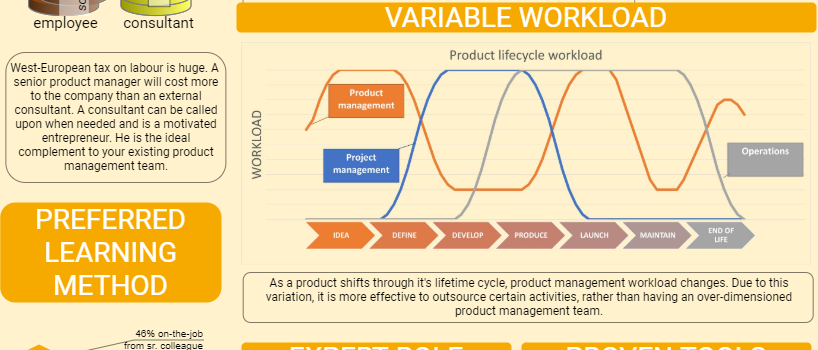
- Product management is a variable workload.
- External input creates a broader vision and higher growth.
- Efficiency through established methods and standard tools.
- It is the product manager’s preferred way of learning.
Download pdf poster version here.
Outsourcing Product Management is cost-effective.
When calculating the actual full cost of an employee, it turns out that outsourcing is less expensive. The calculation below is based on Belgian legislation and statistics.
Full-time product management employee – real cost
| Name | Amount | Info |
|---|---|---|
| REMUNERATION / YEAR | ||
| Monthly gross salary | 5.244 € | = yearly gross salary /13,92 (including holiday pay and end-of-year bonus) |
| Yearly gross salary | 73.000 € | https://www.productfocus.com/product-management-resources/industry-survey/ |
| Employer’s contribution | 27.206 € | 27,15% (based on Q1/2021; > 20 employees) |
| Company car | 7.696 € | Audi A4 at 530€ / month excl. VAT + max. 50% of tax deductable |
| Fuel card | 1.564 € | 25.000 km/year; consumption = 5l/100km; average Diesel price 2020 = 1,36€ – 50% tax deductable |
| Company phone subscription | 295 € | Proximus 24,55€ / month excl. VAT |
| Meal vouchers | 1.506 € | 218 working days; max. employer contribution = 6,91 € Legal info here. |
| Eco-vouchers | 250 € | max. 250€ / year Legal info here. |
| Group insurance employer contribution | 3.808 € | 6% of gross salary |
| Collective hospitalization insurance | 1.800 € | 80% of employees in Belgium are covered by collective insurance. |
| Result-based bonus | 1.280 € | = Average 2020 per Acerta research |
| Travel compensation | 2.027 € | Assume 10% travel rate; payment per official officer’s flat rate; travel to Netherlands rate |
| Training & education | 5.000 € | Per law “werkbaar & wendbaar werk” (2017), target is set to 5 education days per year per employee (legal right = 2 days). |
| Company events, relational gifts, social activities | 500 € | Estimate |
| GENERAL COSTS /YEAR | ||
| Infrastructure | 7.389 € | source: study Colliers Occupier Cost Index (OCI) 2019 = rent, fit out, furniture, taxes, maintenance, cleaning, utilities. note: NEN1824 requires 7m² office space / person |
| People & organisation | 1.414 € | source: study Colliers Occupier Cost Index (OCI) 2019 = catering, document management, office supplies, reception, security |
| ICT | 2.495 € | source: study Colliers Occupier Cost Index (OCI) 2019 = hard- & software, connectivity services, training. |
| Management | 674 € | source: study Colliers Occupier Cost Index (OCI) 2019 = strategic & tactical management of the organisation. Facility management, service desk, procurement. |
| Recruiting cost | 1.000 € | Average recruiting cost = 10 K€; job transition = 10% (= 10 years on the job) (source: Securex) |
| Occupational accident insurance | 409 € | Legally required for every employee. Est. 0,65% |
| COST OF ABSENTEISM /YEAR | ||
| Short illness | 2.713 € | On average, Belgians are 2,79 on 100 days absent due to short illness. (including long-term absences, this becomes 5,88% !) This should be accounted for extra cost on remuneration. |
| TOTAL /YEAR | ||
| 142.108 € |
Product manager consultant cost
| Description | Cost |
|---|---|
| Hourly rate | 80 € |
| Daily cost (8 hours) | 640 € |
| Monthly cost | 11.627 € |
| Yearly cost (218 working days) | 139.520 € |
Considering all expected expenditures of an internal product manager, this turns out slightly more expensive than an external consultant. Note that we are comparing the AVERAGE product manager cost here while the consultant is assumed to be a senior experienced leader. The remuneration of a senior product manager is at least 10% higher than what we used here (80 a 100 K€) which will increase the difference significantly!
Of course, an internal product manager represents a firm commitment that can be very expensive to terminate if the cooperation turns out not to be satisfactory while a consultant contract is easy to terminate without any cost. This cost of dismissal and/or reorganization is not accounted for in above.
Ideally, your product management team is a combination of employees and consultants as further arguments will show.
Product management is a critical function, it deserves an expert
Products are the lifeblood of your company. For sure, people are a valuable asset – as the cliché goes – but there is no sales, no income, no purpose for existence without products. (Consider ‘products’ here as either tangible goods, hardware or software, or non-tangible services.) Building and maintaining a solid product portfolio is the base on which a company needs to get its revenues. Still, many companies have a high failure rate when it comes to product related processes.
According to a study by the world-leading Project Management Institute, 35% of projects fail, 38% run over budget, 45% were late and 27% missed the goal. In the 2020 version of this annual report, PMI identifies the top 3 skills that are required for improving project success rate: technical skills, leadership skills and business skills. This combination of skills is exactly what identifies a strong, experienced product manager.
Even when trying to expand the portfolio and market through merger or acquisition, business fail dramatically. According to Harvard Business Review, between 70% and 90% of M&A are no success. Whatever the reason (explanations differ), a product manager with expertise across different business and industries can contribute significantly to strategic discussions about identifying potential inorganic growth.
By outsourcing product management activities, you gain access to an experienced, senior product manager, which may be hard to get in the common labor market or come at a price that is much higher than calculated above.

Product management is a variable workload.
All products go through a lifecycle, from idea conception over market growth to phase-out. It is a team effort and the role of the product manager is not always the primary one. As a product moves from definition to development, a dedicated project manager will ideally take the lead to control scope, budget and time. The product manager reappears on the scene when the commercial launch is due. During the product lifetime, the operations and customer services department will be in lead for all day-to-day activities. When a product reaches end-of-life, the product manager will most probably orchestrate the final deliveries and introduce a new replacement product.
Due to this variation in workload, it is more effective to outsource certain activities, rather than to have an over-dimensioned product management team.

External input creates a broader vision and higher growth.
After spending many years in a certain company or business, people can become “short-sighted”. One gets locked into the familiar environment and looses the capability to look beyond the borders of a classic company culture.
By bringing external advisors into the company, a new vision can be developed. Elements from adjacent industries can be used to strengthen one’s own portfolio. Senior product manager consultants who have spent several years in different companies, business units or even adjacent industries will develop an “out of the box” way of thinking that allows them to bring the best elements from one area to another, in other words: the gift of cross-fertilization.
It is that enhanced vision that will allow to escape from mediocrity and create growth beyond what is possible within the boundaries of the company.

Efficiency through established methods and standard tools.
Experienced product management consultants come with a bag of tools and best practices. They have seen methodologies succeed and they have seen hypes fail. They have seen tools being efficient in one case while they were inadequate in another. Some tools size with growth while others are only efficient for a specific volume. They have experimented with approaches, invented their own methods sometimes and combined tools in innovative ways to multiply the efficiency.
Using the right instrument for each job is critical for efficiency. As the law of the hammer – often attributed to Maslov and / or Kaplan – dictates: for someone with a hammer, every problem is a nail. Driving down a nail in a wall with a screwdriver will be challenging but using a hammer to stick a memo to the bulletin board is just as inefficient.
Fact is that in complex business today, no two businesses are identical and no two problems are the same. Product management does not come with a clear instruction manual that identifies the cure for every disease. Hence the value of an experienced guru or a coach that can advise and guide in making the right decisions at the right time, regardless of the circumstances.
Despite the wealth of software programs nowadays that is supposed to relax the load on management, I do want to make a case for the use of commonly accepted and industry standard tools though. In today’s business, it is no longer possible to survive inside one’s microsphere. Every business needs suppliers, partners, advisors, teamwork, etc. to succeed. That means that sooner or later information will have to be shared and exchanged between parties that did not work together before. At that time, it will become very clear that sticking to standards is a requirement to maintain leadership. Having to convert information before transferring will lead to a loss off information and resources in that process. It sometimes even comes down to simple language. I am still surprised sometimes to see people in global companies document stuff in their local language, as if it will never have to be shared. The same applies to tools: it can be great fun and impressive to use the latest hype tool but chances are high that it will limit flexibility and growth. The experience and wisdom of understanding and foreseeing the limitation of tools is just as important as knowing it’s capabilities. Again, a senior product management consultant can avoid costly mistakes on that level.

The product manager’s preferred way of learning.
In March 2021, I launched a quick poll in 5 dedicated Product Management LinkedIn groups with over 300.000 users worldwide. The goal was to find out what medium Product manager’s prefer to improve their Product Management competence. As Product Managers tend to be very busy ( – too often with firefighting – ) I suspected they would choose for the least time-consuming method.
The Question was “How do you prefer to learn about product management or increase your product management competence?”. The possible answers are shown below with their response rate.
| Answer | Score |
|---|---|
| Reading good books | 25 % |
| Instructor-led training | 2 % |
| Online training on demand | 7 % |
| On-the-job from sr. colleagues | 46 % |
This shows indeed a preference for methods that provide a superior level of practical knowledge and allow the product manager to control 100% himself how much time to allocate, when to spend it and what to learn. Class-room and online trainings often have a tendency to be long-winded and always contain subjects that are already know or mastered. A book can be chosen that is handling specific subjects of interest and less interesting chapters can be skipped. It can be read at any time, even during out-of-office hours. A mentor on the job can be consulted when needed while the usual work gets done. Working with an experienced product management consultant will boost the maturity of the existing product management team and make it self-sustaining in the best way.
One Response to “6 good reasons to outsource product management”
Leave a Reply
As a freelance Product Management Consultant I could not agree more with your findings. I find that crossover between industries, or market sectors is very useful, as is the use of sector favourite tools.